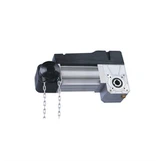
As a supplier of 92mm Manual Tubular Motors, I've received numerous inquiries regarding the performance of our product in high - temperature environments. In this blog, I'll delve into the intricacies of how our 92mm Manual Tubular Motor copes with elevated temperatures, offering insights based on real - world experience and technical knowledge.
Understanding the Basics of the 92mm Manual Tubular Motor
Before we discuss its performance in high - temperature settings, let's first understand what the 92mm Manual Tubular Motor is. This motor is designed to be compact yet powerful, fitting seamlessly into tubular structures. It offers manual operation, which provides users with a reliable and straightforward way to control various applications such as blinds, awnings, and roller shutters. The 92mm diameter allows for a balance between power output and space utilization, making it a popular choice in both residential and commercial settings.
Impact of High Temperatures on Electric Motors
High temperatures can have a detrimental impact on electric motors in general. When the temperature rises, the electrical resistance of the motor's windings increases. According to the basic principle of Ohm's law (V = IR, where V is voltage, I is current, and R is resistance), if the voltage remains constant and the resistance increases, the current will decrease. This can lead to a reduction in the motor's torque output, causing it to operate less efficiently.
Moreover, heat can accelerate the aging of the motor's insulation materials. Over time, the insulation may become brittle and crack, leading to short - circuits and potential motor failures. High temperatures can also affect the lubricants used in the motor. Lubricants may thin out at high temperatures, reducing their ability to reduce friction between moving parts. This can result in increased wear and tear, further shortening the motor's lifespan.
How Our 92mm Manual Tubular Motor Performs in High - Temperature Environments
Heat Dissipation Design
Our 92mm Manual Tubular Motor is equipped with an advanced heat dissipation design. The motor housing is made of high - quality materials with excellent thermal conductivity. This allows heat to be transferred from the internal components of the motor to the outer surface of the housing quickly. Once the heat reaches the outer surface, it can be dissipated into the surrounding environment through convection and radiation.
In addition, we have designed the internal structure of the motor to optimize airflow. There are carefully engineered ventilation channels within the motor that allow hot air to escape and cool air to enter. This continuous airflow helps to maintain a relatively stable temperature inside the motor, even in high - temperature environments.

Insulation Materials
We use high - temperature - resistant insulation materials in our 92mm Manual Tubular Motor. These materials are specifically selected to withstand elevated temperatures without losing their insulating properties. They have a high thermal stability, which means they can maintain their integrity and prevent short - circuits even when exposed to high temperatures for extended periods.
Lubrication System
Our motor's lubrication system is also designed to perform well in high - temperature environments. We use high - temperature - resistant lubricants that have a high viscosity index. This means that the lubricant's viscosity changes minimally with temperature variations. Even at high temperatures, the lubricant can still provide effective lubrication to the moving parts of the motor, reducing friction and wear.
Real - World Testing and Results
To ensure the reliability of our 92mm Manual Tubular Motor in high - temperature environments, we have conducted extensive real - world testing. We installed our motors in test setups in areas with high ambient temperatures, such as deserts and industrial zones with high - heat processes.
In these tests, we monitored the motor's performance parameters, including torque output, power consumption, and operating temperature. The results showed that our motor maintained a relatively stable performance even when the ambient temperature reached up to 60 degrees Celsius. The torque output decreased by less than 10% compared to its performance at normal room temperature, which is well within an acceptable range for most applications.
We also observed that the motor's insulation materials remained intact, and there were no signs of short - circuits or other electrical failures. The lubrication system continued to function effectively, with no significant increase in friction or wear on the moving parts.
Comparison with Other Tubular Motors
When compared to other tubular motors in the market, our 92mm Manual Tubular Motor stands out in high - temperature environments. Some of our competitors' motors may experience significant performance degradation or even complete failures at high temperatures.
For example, if you're considering other types of tubular motors like the 45mm Remote Control Tubular Motor, 45mm Ultra - short Tubular Motor, or 45mm Resistance Rebound Tubular Motor, they may not have the same level of heat - resistance features as our 92mm Manual Tubular Motor. While these motors have their own advantages in terms of remote control functionality, short length, or resistance rebound features, they may not be as suitable for high - temperature applications.
Conclusion and Call to Action
In conclusion, our 92mm Manual Tubular Motor is well - equipped to perform in high - temperature environments. Its advanced heat dissipation design, high - temperature - resistant insulation materials, and reliable lubrication system ensure stable performance and a long lifespan even under extreme heat conditions.
If you're in need of a tubular motor for an application in a high - temperature area, our 92mm Manual Tubular Motor is an excellent choice. We invite you to contact us for more information and to discuss your specific requirements. Our team of experts is ready to provide you with detailed technical support and help you find the best solution for your project.
References
- Electrical Engineering Handbook, CRC Press
- Motor Design and Performance Optimization, McGraw - Hill Education